Best Portable Car Lifts for Classic Cars & Collectors: How to Lift, Store, and Protect Your Ride Without a Permanent Install
If you own a classic car or special ride and you don’t have a big shop, you know the struggle.
You want to work on your car, store it safely, or just get it up off the ground to free up floor space. Floor jacks feel sketchy, jack stands are a pain, and a permanent lift eats up room.
What if you could lift your car high enough for proper work and still store the lift under a shelf when you are done? That is exactly where a portable car lift system becomes your best friend.
Problem:
Many classic-car owners, small shops, or restoration teams lack space for a full-size 2-post or 4-post lift.
Traditional lifts require heavy concrete floors, high ceiling heights, and anchoring—expensive and often impractical.
Jack stands or ramps feel unsafe, unstable, or just like too much work.
Why typical “solutions” fall short
Jack stands and ramps that don’t give full undercarriage access are unsafe and often require repositioning.
Permanent lifts eat up space, require floor modifications, and tie you down to one location.
Scissor lifts or single-use jacks limit access, may not support heavier or longer vehicles (such as classic cars/trucks), and may lack safety features.
Our solution: portable car lifts & portable car hoists
You can roll them under a vehicle, lift it, lock it mechanically, work comfortably, and then store the frames out of the way—perfect for multi-use garages or small shops. Pro-Series Equipment + 2 HeavyLiftDirect + 2
Many modern portable lifts meet safety standards, with mechanical locks, stable frames, and good lifting capacity.
What Defines a Good Portable Car Hoist
Not all car lifts are created equal. Here’s what you need to watch when picking a portable lift:
Types of lifts: There are folding-frame/floor-jack-style portable lifts, two-post portable lifts, and scissor or hydraulic jacks. Each type gives different tradeoffs in portability, stability, and clearance.
Lifting capacity: Make sure the lift supports more than your car’s weight. Many portable lifts range from 3,500 lbs (for small cars) up to 7,000–8,000 lbs (for heavier classics or light trucks).
Mobility and storage: Good portable lifts fold or have removable frames, often with casters/wheels. That way, you can store them when not using them or roll them out only when needed.
Safety features and build quality: Lifts should have mechanical locks, sturdy steel, and comply with lift-industry safety standards where possible (e.g., certification labels). Avoid sketchy or overly cheap units.
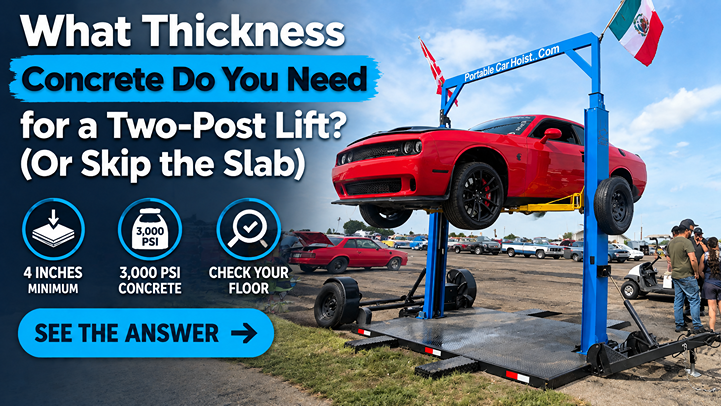
Garage/floor compatibility: You need a flat, level, solid surface (like concrete) for safety. Lifts on uneven or soft ground are a no-go.
When a Portable Lift Makes the Most Sense
Here are common use cases where portable car lifts shine for classic-car owners, collectors, and small-shop mechanics:
Periodic maintenance or restoration: Brakes, suspension, exhaust, undercarriage rust, or restoration work. A portable hoist gives easy access without a full shop setup.
Long-term storage and space saving: Lift your show car out of the way, and use the floor space below for another vehicle, storage, or workspace.
Home garage or small shop with limited space: No room for a permanent four-post or in-ground lift. Portable lifts give flexibility without footprint sacrifices.
Mobile work or pop-up bays (for small shops or clubs): If you work on cars at events, shows, or temporary locations, having a portable lift you can transport is a big plus.
What to Watch Out For (Safety & Common Mistakes)
A lift can be a great tool, but only if used correctly. Common pitfalls:
Overloading the lift: Don’t assume it can hold your car until you verify its weight vs lift capacity—older cars can be heavy.
Bad floor or ground conditions: Soft ground, uneven floors, or poorly leveled surfaces make lifting dangerous.
Ignoring proper lift points or balance: Incorrect arm placement, uneven distribution, or sloppy positioning can destabilize the car. Always follow the manufacturer's instructions.
Leaving cars on a portable lift long-term (unless designed for it): Some portable lifts are meant for repair/access, not indefinite storage—check specs and safety guidelines.
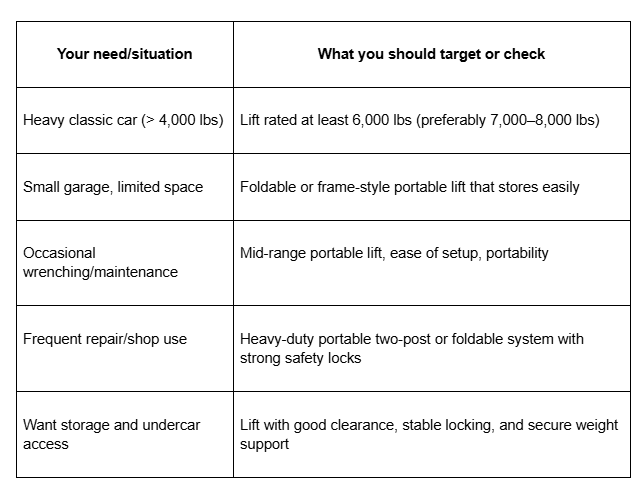
Quick Decision Checklist: Which Lift Is Right for You
If you want to decide quickly which portable lift fits your situation, run through this checklist and write down what you need.
My Recommendation (If I Were You)
If I had a classic car and a mid-size garage, I would go with a portable two-post lift or a foldable frame-style lift with a capacity of around 6,000–7,000 lbs. That gives me flexibility: I can lift the car when I need to work or store it overhead, then fold and stow the lift to keep the floor clear.
If I planned to do regular maintenance or occasional shop-level work, I’d pick a heavier-duty portable lift with safety locks and a solid frame, even if it costs more. Safety and reliability matter more than saving a few bucks, especially on a classic ride.
Ready to Get Started: What to Do Next
Write down your car’s gross weight, wheelbase, and type (sedan, long-wheelbase, truck, SUV, etc.)
Measure your garage floor, ceiling height, and floor type (must be solid, flat concrete)
Decide how you plan to use the lift (storage only, occasional maintenance, frequent workshop-style work)
Compare lift models that match your specs—capacity, portability, safety features
If unsure, reach out to manufacturers or suppliers with your car specs and ask if their lift is rated for your use
If you want, I can build a full buyer’s guide (with 5–10 recommended portable car lift models, pros/cons, and tailored options based on garage size and car type). That would help you or a buyer pick confidently without sorting through dozens of unclear specs.