



Jader Gil
Marketing Expert
June 6, 2026
9 min read
You have a car that needs work. Maybe it's a weekend restoration job, a growing mobile mechanic route, or a race weekend coming up fast. Either way, you need to lift that vehicle, and the first question most people land on is, "Should I rent a car lift or just buy one?"
It sounds straightforward. But once you run the real numbers, the answer changes pretty fast for most people in this industry.
Let's talk through it honestly.
Here's what usually happens. You need a lift for a job. You search "car lift rental near me," find something, pay for a week, and the job gets done. Simple enough.
But then the next job comes up. And the one after that. Before long, you've paid for five or six rentals over the year, and you have nothing to show for it. No equipment. No asset. No tool in your shop that you own.
Car lift rental providers are fewer than you'd expect, and many that do pop up tend to close down fairly quickly, largely because of insurance complications and low demand. That means availability is already a problem before you factor in anything else.
And even when you do find a rental, the costs add up fast. Average rental rates at DIY garage facilities run around $30 per hour, $125 per day, or $360 per week. If you're using a hoist two or three times a month, that's between $720 and $1,080 a month walking out the door. Every month.
That's the problem nobody says out loud when you're standing at the counter filling out a rental agreement.
Let's put some real numbers on this so it's not just a feeling.
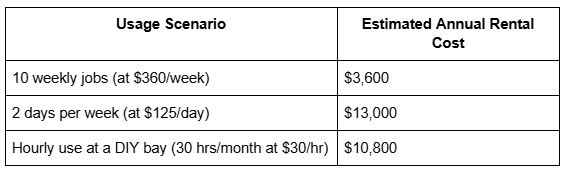
Now compare that to owning a portable car hoist outright. A quality American-made portable unit built for professional use runs considerably less than the annual rental cost for anyone working under cars regularly. And that purchase price doesn't repeat itself every year.
The break-even math on car lift rental vs buying is usually somewhere between 8 and 14 months of moderate use. After that, every job you complete on your own equipment costs you nothing extra in lift fees.
Some costs never show up in the rental quote: delivery fees, fuel surcharges, damage waivers, and the time you spend coordinating pickup and drop-off. None of that gets back to you.
To be fair, renting isn't always the wrong call. There are situations where it actually fits.
Renting makes sense when:
Renting stops making sense when:
If two or more of those second-category items apply to you, the car lift rental vs buying calculation has already answered itself. Ownership wins.
Most rental lifts are fixed or semi-fixed two-post or four-post units. They work fine for what they are. But they don't adapt to you.
Renting a car lift isn't quite the same as renting other equipment. You don't bring the lift to your garage; you bring your car to a garage that rents you time on their lift. That creates a logistical problem for anyone doing mobile work, on-site service calls, or racing event prep.
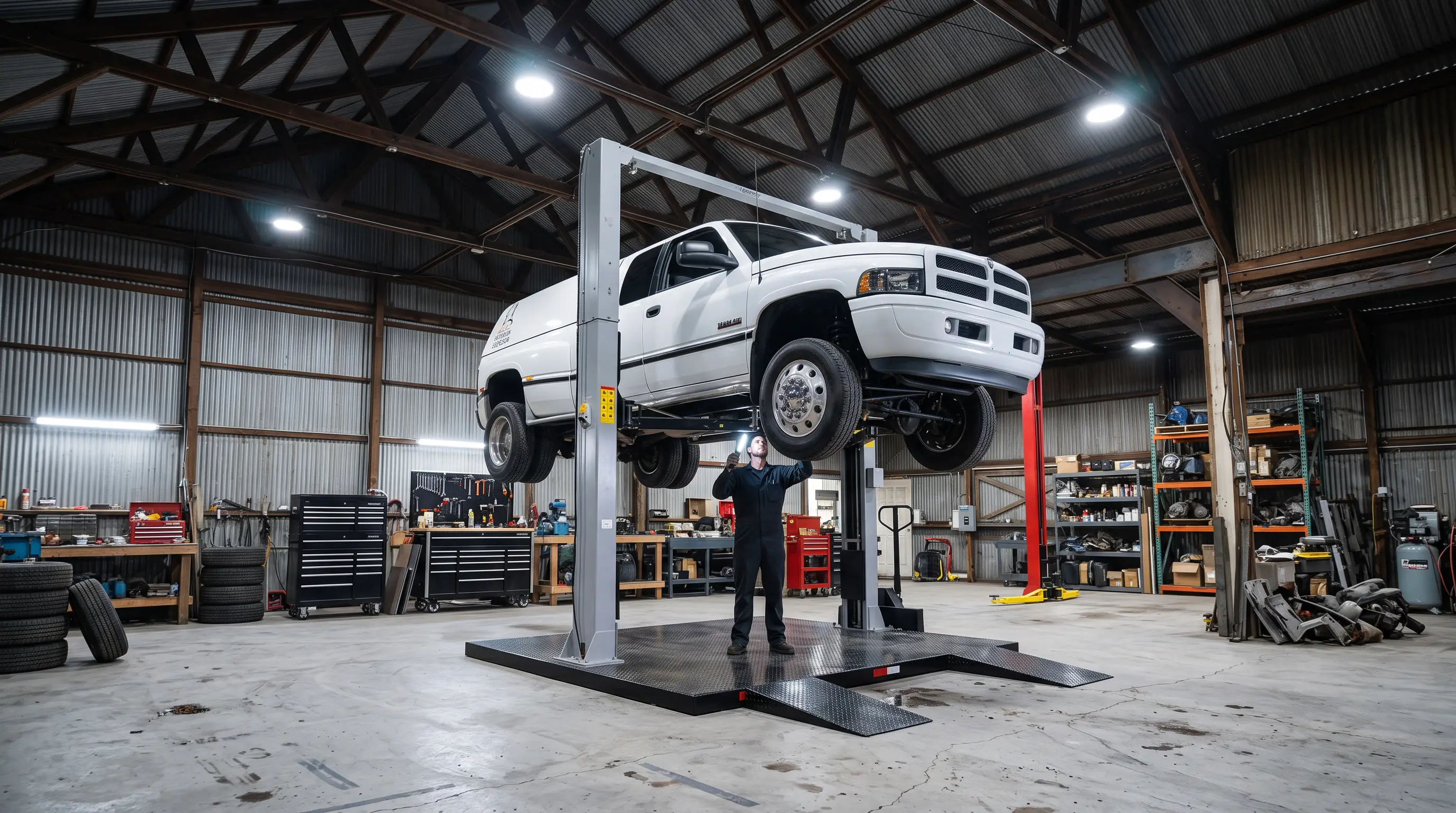
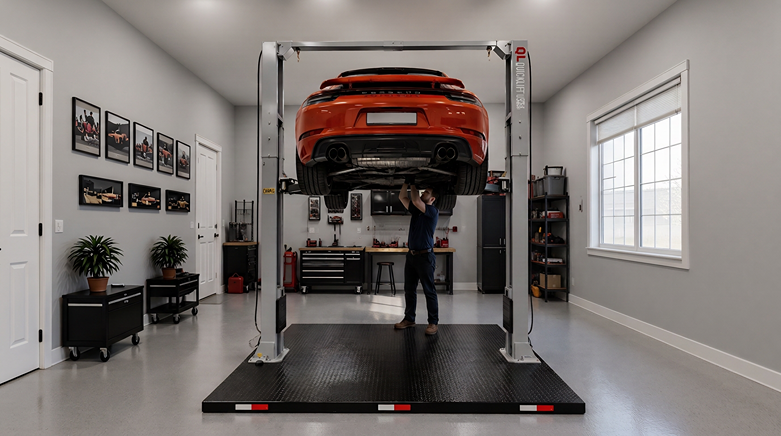
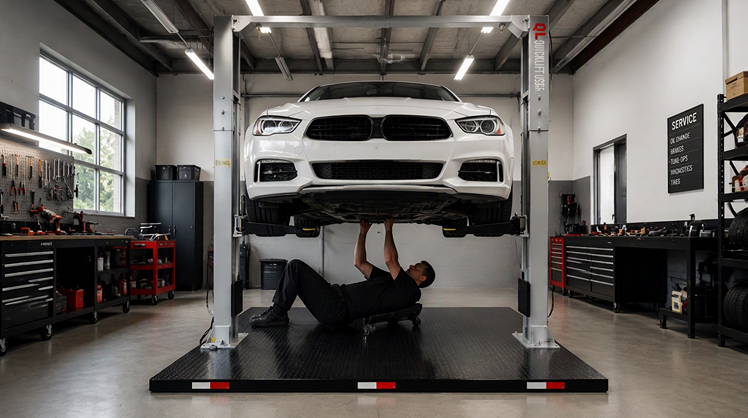
A portable car hoist is built differently. Units from Portable Car Hoist, made in Menifee, California, require no concrete, no permanent installation, and no permits. You set them up in minutes on a driveway, a parking lot, a race paddock, or a commercial bay. Then you pack them up and move them when the job is done.
The capacity range covers most professional needs, from standard passenger vehicles all the way up to 76,000 lbs on commercial models. That means the same unit that handles a weekend track car can also work on fleet vehicles and heavy trucks.
A traditional two-post car lift in 2025 runs between $2,700 and $9,000 before installation costs, and installation alone for a fixed unit can add another $4,000 to $8,000 on top. A fixed lift also locks you into your current floor plan. If you move shops, that lift stays behind.
A portable hoist goes where you go. That's a meaningful difference if your work isn't always done at one address.
If you run a shop, here's a frame that might help.
In the automotive repair industry, shops typically aim for labor profit margins of 40 to 70 percent. Every job you complete faster and more efficiently improves that number. A lift you own and can use on your schedule, without booking in advance or worrying about availability, directly impacts how many cars you can move through in a week.
Rental equipment has two hidden costs that don't show up on the invoice: the time you spend arranging it, and the jobs you can't take because the equipment isn't available when you need it. A shop that turns away two transmission jobs in a month because the rental unit is out with someone else has already lost more than the cost difference between renting and owning.
The Auto Care Association reports that the U.S. automotive repair and maintenance industry generated over $116 billion in revenue in 2023. Shops that invest in reliable, flexible equipment tend to handle more volume and have lower downtime. Equipment ownership is one of the clearest levers they can pull.
If you're a mobile mechanic or you organize race events, the car lift rental vs. buying question has a clearer answer than it does for almost any other user type.
Mobile mechanics can't rent a fixed lift and carry it to a customer's driveway. The rental model fundamentally doesn't work for that use case. You either own portable equipment or you're limited to floor jacks and jack stands, which slows you down and limits the jobs you can take.
A portable hoist that fits in a truck bed or trailer changes what your business can offer. You can take on jobs that other mobile mechanics pass on. You work faster, work safer, and charge accordingly.
For race event planners, the situation is similar. Rental companies typically don't deliver automotive lifts to racetracks or paddocks. And if they do, the logistics are expensive and complicated. Owning a portable unit that breaks down quickly, fits in a trailer, and sets up without tools means you control your own timeline at every event.
Before you book your next rental, run through these three questions.
If the answer is more than five, you've probably already spent enough on rentals to cover a significant portion of a purchase.
Most general rental lifts weren't designed for the specific jobs you do. If you're lifting low-clearance vehicles, working in tight spaces, or moving between job sites, a purpose-built portable unit fits your workflow better than whatever the rental yard happened to have available.
This is the question that usually changes the math. Jobs declined, delays on your own vehicles, and race weekends where you had to improvise. That's the real cost of not owning.
The car lift rental vs buying question looks like a pricing question, but it's really a business decision. Renting feels cheaper at first because the cost comes in smaller chunks. But those chunks keep coming, and after a year or two, you've spent more than the price of ownership, and you're still starting from zero every time you need a lift.
A Portable Car Hoist gives you something a rental never will: equipment that's yours, moves with you, and earns back its cost every time you use it. No concrete. No permits. No availability problems. Just a lift that shows up when you need it because it lives in your shop, your trailer, or your truckbed.
If you're working under vehicles regularly and still renting, the math has probably already turned against you.
See which Portable Car Hoist model fits your work. Get a free quote today at portablecarhoist.com/contact or call +1 (951) 400-5290.