



Jader Gil
Marketing Expert
April 1, 2026
9 min read
You are halfway through a brake job. The floor jack is holding the car, you are flat on your back, and then you hear it. The sound of shifting metal reverberates through your body. Then nothing for a split second, and then the car drops.
That moment happens more than you probably think.
The numbers are not abstract. According to the NHTSA, roughly 4,822 people are treated in U.S. emergency rooms every single year for injuries tied to jack failures. That is nearly 5,000 people who went to work on a car and ended up in a hospital instead. And that figure does not count the deaths, the near misses, or the incidents that never got reported because someone was too stubborn, too scared, or too proud to go to the doctor.
This post is not here to scare you. It is here to be straight with you about something a lot of mechanics and car enthusiasts quietly know but rarely talk about: the floor jack, for all its convenience, is one of the most dangerous tools in your shop.
Most people assume the jack will just hold. You pump it up, tuck it under the rocker panel, slide underneath, and get to work. The problem is that the assumption has put a lot of people in the ground, or at the very least, in a cast.
The NHTSA data is clear on this: 74% of jack failures happen because the jack or the vehicle slips, not because the hydraulic system gives out. That means most accidents are not the result of a defective product. They are the result of normal use on real-world surfaces that are never quite as flat or as stable as you need them to be.
Here is what that looks like in practice:
None of these scenarios requires a bad jack. They just require normal human behavior under real working conditions.
And the injuries that follow? They are not minor. The NHTSA study found that 39% of the most severe injuries were to the hands, fingers, or wrists, and another 15% involved the head, neck, or face. When you are lying flat under 4,000 pounds of steel, there is no good way for that to fall on you.
Let's get into the money, because that matters too, especially if you run a shop or operate as a mobile mechanic.
A single workplace injury claim can cost a small shop anywhere from $10,000 to $50,000 when you factor in:
OSHA has specific regulations under 29 CFR 1910.244 that cover portable jacks in general industry. If an inspector finds that a vehicle fell because proper jack stand procedures were not followed, the fines can be significant, and that does not include what happens if someone sues.
The 2020 Harbor Freight recall of over 1.7 million Pittsburgh Automotive jack stands is a good example of how this plays out at scale. Those stands were recalled because of a manufacturing defect that could cause a sudden, unannounced collapse. Eleven non-life-threatening injuries were reported before the recall happened. That is eleven incidents before the public found out the product was dangerous.
How many incidents went unreported? Nobody knows.
You will not find names here, because these are the kinds of stories people share in shops, not in press releases. But they are real.
A mobile mechanic in Texas was doing a routine oil change in a client's parking garage. The floor had a slight grade that was invisible to the naked eye. The jack stand shifted while he was under the car. His shoulder took the impact when he rolled, and he was out of work for six weeks. Six weeks of zero income, plus the medical bills, plus the cost of finding coverage for his existing clients. His business nearly did not survive it.
A shop owner in Florida ran a tight two-bay operation for eleven years without a single serious incident. Then, a junior tech used a floor jack that had a slow hydraulic leak the owner did not know about. The car lowered itself over about forty minutes while the tech worked underneath. He got out. But only because he noticed the creeping movement early enough to scramble. The owner replaced every floor jack in the shop that week.
A car collector in California had a vintage Porsche on jack stands for a weekend restoration project. One stand was placed on a rubber mat over concrete. The mat compressed unevenly overnight. He came back Sunday morning to find the car had rolled approximately two inches and was resting against a workbench. The car sustained $8,000 in body damage. No injury, but the car was never quite the same.
These are not horror stories from amateurs. These are professionals and enthusiasts who knew what they were doing. The jack just did not care.
Here is where the conversation shifts, because understanding the problem is only useful if you do something about it.
The real solution for mechanics, collectors, and shops is not a better floor jack. It is moving away from floor jacks entirely for any job that requires working underneath a vehicle. This is where car lift alternatives become not just a preference but a practical safety decision.
Portable car hoists, like the models offered at Portable Car Hoist, are built around the idea that you should not need a permanent installation to have a real lift. No concrete anchors. No permits. No costly construction work in your shop or garage. You set it up where you need it, and you work from a position of actual stability.
Compare that to a floor jack setup:
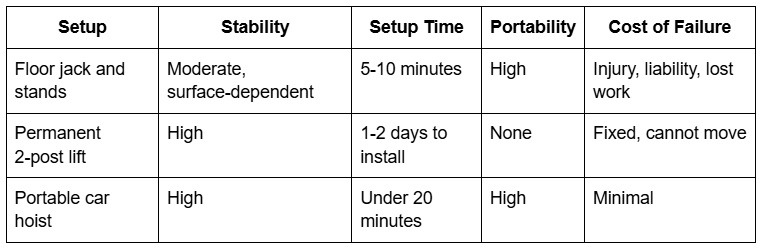
Car lift alternatives like portable hoists are especially valuable for mobile mechanics who cannot predict the surface conditions at every job site. If you are working in a customer's driveway, on gravel, on asphalt, or in a parking lot, a floor jack is asking for trouble. A portable lift gives you the height clearance and the stability that the job actually requires.
The shift toward car lift alternatives is not a trend driven by fancy marketing. People make this shift after experiencing a setback or witnessing someone else's failure.
For mechanic shops, the calculation is straightforward. A quality portable hoist costs a fraction of a permanent lift installation and does not require you to tear up your floor. You can also use it across multiple bays, take it to off-site jobs, or store it when you need the space for other work.
For car collectors, the appeal is about protecting what you love. A vintage vehicle on jack stands is exposed to every variable in your garage, including temperature shifts that affect rubber pads, concrete that is not always perfectly level, and just the general anxiety of leaving a prized car sitting on four small points of contact for days or weeks.
For event planners and race teams, portable car hoists solve a problem that floor jacks simply cannot: you need lift capability at a venue that has no permanent infrastructure. You bring the lift with you, set it up in the paddock or on the show floor, and you work safely without improvising.
The common thread across all of these groups is the same. Car lift alternatives give you the safety of a real lift without the commitment of a permanent installation.
Not all car lift alternatives are created equal. Here is what actually matters when you are evaluating options:
Weight capacity: Make sure the lift is rated for the heaviest vehicle you regularly work on. A lift rated at 6,600 lbs gives you a real margin for trucks, SUVs, and commercial vehicles.
Surface adaptability: The best portable hoists work on concrete, asphalt, and packed surfaces. If a lift requires perfectly flat concrete, it is not much better than a jack stand for real-world use.
Setup time: If setup takes longer than the job, mechanics will skip it and go back to the floor jack. Look for systems you can deploy in under 20 minutes with one person.
Height clearance: For any undercarriage work, you need enough lift to actually move around, which refers to the vertical space required to safely work under a vehicle. Low-profile options might look good for storage, but they fail you when you are trying to access a transmission.
No permanent install: This is the core of what makes portable car hoists valuable. The moment you need permits or concrete work, you have eliminated the flexibility that makes them worth it.
Nearly 5,000 people end up in emergency rooms every year because of floor jack failures. The majority of those incidents are not product defects. They are the predictable result of using tools that were not designed for the kind of stability that serious automotive work actually demands.
You already know floor jacks are a risk. Most mechanics do. The question is whether you treat that risk as acceptable because it is familiar, or whether you start looking seriously at car lift alternatives that give you the safety, the portability, and the peace of mind that the work deserves.
The stories above are not outliers. They are what happens when convenience wins over safety enough times.
If you are a mechanic, a collector, or a shop owner who has been thinking about making the switch, now is a good time to actually look at what is available. Portable Car Hoist has models built for professional use, mobile applications, and everything in between. No concrete. No installation. Just a lift that works where you work.
Ready to stop relying on floor jacks for jobs that need a real lift?
Visit portablecarhoist.com to explore your options, or call +1 (951) 400-5290 to talk through what fits your shop, your vehicle, and your work style. The consultation is free. The information you get is worth a lot more than that.