


Jader Gil
Marketing Expert
April 1, 2026
9 min read
You've got cars waiting in the lot. You've got a tech standing around because the lift is tied up. And there is an estimate resting on the desk for a project whose scheduling you are uncertain you can accommodate within this week.
Sound familiar?
If you run a collision shop, you already know the frustration. Your lift is your bottleneck, and your bottleneck is quietly costing you money every single week.
Here's the thing: you don't necessarily need a bigger shop or a $20,000 fixed installation to change that. A portable car hoist might be exactly what closes the gap between the work you're doing and the work you could be doing.
Let's talk about what's actually happening, why it keeps happening, and how to fix it.
Most collision shops run one or two fixed lifts. They're bolted to the floor, they're permitted, and they're not going anywhere. That setup works fine when business is slow. But the moment volume picks up, that fixed equipment becomes the single point of failure for your whole operation, potentially leading to significant delays and financial losses if it malfunctions or requires maintenance.
According to IBISWorld, the auto body repair industry in the United States generates over $47 billion in annual revenue, with over 66,000 businesses competing for that share. And yet, a 2022 survey by the Automotive Body Parts Association found that over 60% of independent collision shops reported turning away work due to capacity constraints.
60%—that's not a small thing. That's a huge portion of the industry leaving money on the table, not due to a lack of skills or customers, but because they literally cannot get the car in the air.
When you're depending on one fixed lift, you're building your entire throughput around a single piece of equipment that can't move, can't scale, and can't be in two places at once.
Fixed two-post and four-post lifts are excellent tools. Nobody's denying it. But they come with real limitations that add up fast when your shop gets busy.
First, there's the installation cost. A quality fixed lift runs anywhere from $3,500 to $12,000 for the unit alone. Add concrete anchoring, electrical work, and permitting (the process of obtaining official approval for construction), and you can expect to pay between $15,000 and $25,000 in total for some locations, depending on your state and city requirements.
Second, there's the floor space issue. A fixed lift is confined to a single location. You can't rotate your bays based on job type. You can't shift things around for a big job or accommodate a specialty vehicle without working around a post that's literally cemented into your floor.
Third, and this one really hurts, your shop can be down for an entire day if that lift needs service. A single malfunctioning hydraulic line or pump can bring your entire operation to a complete stop.
This is the core problem with being lift-limited. And this is exactly where a portable collision repair lift changes your math.
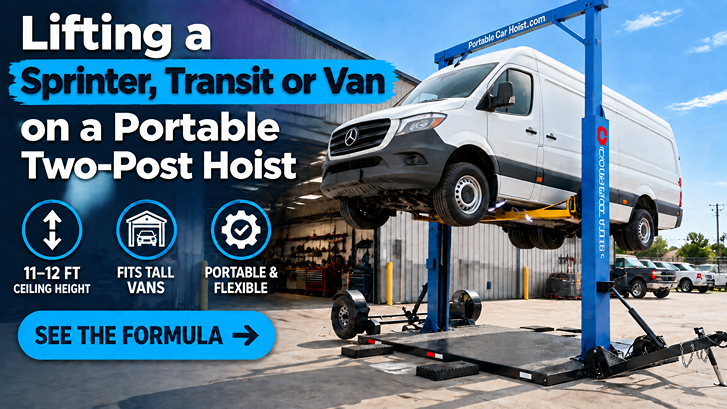
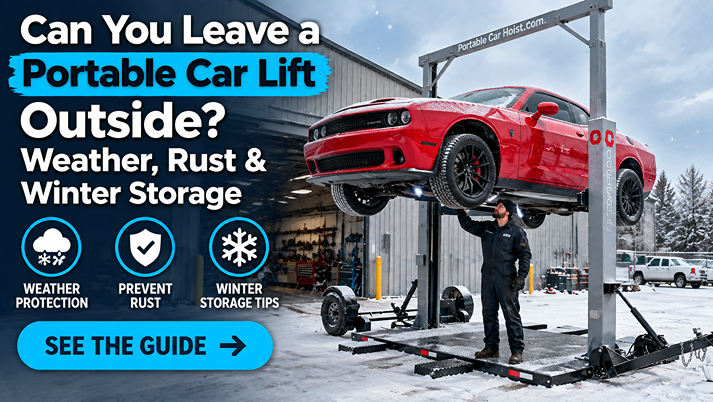
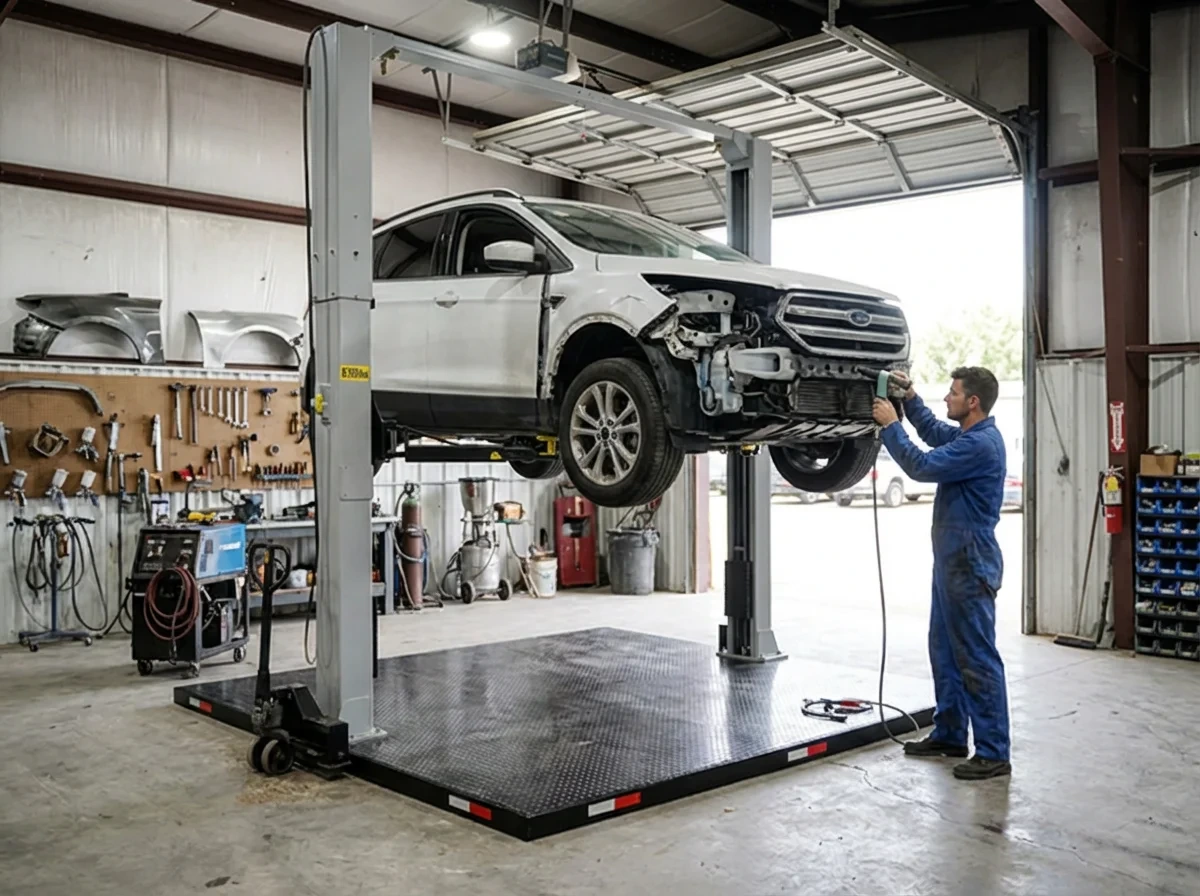
A portable car hoist is a freestanding vehicle lift that requires no floor anchors, no concrete drilling, and no permanent installation. You set it up where you need it, use it, and move it if the job demands something different.
For a collision repair shop, that flexibility is more valuable than it might look at first glance.
Adding a second collision repair lift used to mean committing to a full installation project. With a portable hoist, you add lift capacity incrementally. You can add one unit, test your volume, and add another when the work justifies it. There's no permit delay, no contractor to schedule, and no week of downtime while a crew works on your floor.
Several shop owners who have made the switch report being able to run two to three active repair bays simultaneously for roughly the same cost as one traditional lift installation.
Collision work often involves multiple stages: pulling the damaged area, applying primer, painting, and reassembling the vehicle. With a portable car hoist, you can dedicate a lift to a specific stage rather than running one car through every step on the same equipment. That reduces bottlenecks and keeps your workflow from stacking up.
Fixed lifts are sized for a specific range of vehicles. Portables, especially models designed for a wider weight range, give you the flexibility to take on work that might otherwise send a customer down the street, allowing you to accommodate various vehicle types and increase your service offerings.
This is the real number. If you're currently turning away two or three jobs a week because you're lift-limited, and the average collision repair job runs anywhere from $1,500 to $4,500 according to CCC Intelligent Solutions' 2023 Crash Course report, the math adds up fast. Even a single additional job per week can pay for a portable unit within months.
Not all portable lifts are built the same, and collision shops have some specific needs. Here's what actually matters when you're evaluating a portable car hoist for body and collision work.
Think about a mid-size collision shop doing about 25 cars per week. They have two fixed lifts and a paint booth that sits idle roughly 30% of the time because the lift bay is backed up. They're turning away an average of three jobs a week, not because they don't have the staff, but because they can't get the vehicles in the air fast enough.
Adding one portable car hoist to a corner of the shop, a space previously used for parts staging, allows them to run a dedicated disassembly bay. That one change cut their average cycle time by nearly a full day per vehicle, according to estimates from shops that have made similar adjustments.
At an average repair value of $2,200 per job and three additional jobs per week, that's over $6,600 in additional weekly revenue. Over a year, that's close to $340,000 in gross revenue from a piece of equipment that costs a fraction of a fixed lift installation.
The numbers are not complicated. The only question is whether you're willing to try something that doesn't fit the way shops have always done things.
There are a few myths worth clearing up before you make a decision.
"Portable lifts aren't as stable as fixed lifts."
A well-engineered portable car hoist is designed for the same loads and safety standards as a fixed unit. The difference is in the base design, not the structural integrity. Look for lifts that meet or exceed ANSI/ALI ALCTV standards, the same standards that cover fixed lifts.
"I'll have to move it all the time, and that's a hassle."
Most shops that use portable hoists don't move them daily. They find a home for the unit that adds a second workable lift position, and it stays there. The portability is a benefit when you need to reorganize or expand, not a daily chore.
"My techs won't trust it."
This one is common and fair. Please involve your lead tech in the evaluation process. Let them see the locking mechanism, the load rating, and the build quality. Most skepticism fades when the tech actually gets under a car on a quality unit and sees it holds solid.
Ask yourself a few honest questions:
If you answered yes to two or more of those, the math is already there. The question is just whether to act on it.
The collision repair industry is not standing still. A few things are happening that make flexibility more valuable than ever.
First, vehicle complexity is increasing. ADAS systems, structural aluminum, and new steel grades mean that repairs that used to be quick are now multi-step jobs requiring more time per vehicle. That puts more pressure on lift availability, not less.
Second, insurance cycle times are under pressure. Insurers are pushing shops to reduce days-to-repair, and the shops that can process vehicles faster are getting preferred vendor status. Speed is now a competitive differentiator in a way it wasn't five years ago.
Third, real estate costs for shop space are up significantly in most markets. Adding a fixed lift installation isn't just a capital question; it's a space allocation question. Portable solutions let you do more with the floor space you already have.
The Bureau of Labor Statistics projects a 5% increase in employment for automotive body and related repairers through 2032. More work is coming. The shops that have the capacity to handle it will take the business. The ones that are lift-limited will keep turning it away.
If you're running a collision shop and you're limited by how many vehicles you can get in the air at one time, that's not just a workflow problem. It's a revenue problem with a pretty clear solution.
A portable car hoist lets you add lift capacity without the commitment, the permit process, the contractor schedule, or the five-figure installation bill. It gives you flexibility when you need to stage work differently, take on a larger vehicle, or simply run two bays at once instead of one.
You don't have to overhaul your shop. You just have to stop letting your lift be the reason you turn away work.
If you want to know which portable car hoist model fits your shop's weight requirements, ceiling height, and workflow, talk to the team at Portable Car Hoist. We will have a genuine discussion about your shop's needs and whether a portable solution makes sense for your circumstances, without any pressure or marketing.
Ready to stop turning away jobs? Schedule a free 15-minute consultation at portablecarhoist.com and get matched with the right lift for your collision shop.