



Jader Gil
Marketing Expert
April 1, 2026
9 min read
You spent the weekend turning wrenches. Your back hurts. You knocked over a jack stand for the third time. And somewhere around hour two of lying on a cold concrete floor, you started wondering if there's a better way.
Yes, there is.
Most DIY mechanics put off buying a garage car lift because they think it's too expensive, too permanent, or only for "real" shops. But those same people keep buying floor jacks, stacks of ramps, and creepers, spending more money over time and getting less done.
If you're a DIY mechanic, a car collector, or a car enthusiast (car collectors, car racing), this post will provide you with honest advice. Here are 7 indicators that your current setup is no longer sufficient, along with solutions you can implement without destroying your garage or incurring high costs.
Floor jacks are fine for a quick tire swap. However, if you're performing tasks such as brake jobs, oil changes, suspension work, or any other task that requires you to be under the car for more than 20 minutes, you're facing a significant disadvantage.
Floor jacks fail. That's not a scare tactic; it's a statistic. According to the U.S. Bureau of Labor Statistics, being struck by or caught under a falling object is one of the top causes of injury in vehicle maintenance work. Every year, jack failures contribute significantly to these incidents.
Every time you pump that floor jack, position your stands, and slide underneath, you're relying on a chain of things going perfectly. If you're working on your vehicles regularly, the risk compounds.
This one sounds funny until you think about what it actually means. If you've got permanent marks or cracks in your concrete from jack stands, your floor has been taking repeated point loads it wasn't necessarily designed for.
Garage floors are typically 4 inches of concrete poured to handle cars parked on them, not concentrated loads from metal stands. Over time, this leads to cracking, surface spalling, and, in the worst cases, floor failure under load.
A beneficial portable lift distributes weight across a wider footprint. It can be used on different surfaces, including asphalt, packed gravel, and standard residential concrete, without the same kind of stress concentration.
One of the biggest time wasters in DIY mechanics is the car-lifting game. You get the car up, slide under, realize you can't reach the part you need from that angle, lower it, move a stand, and raise it again.
A proper lift gives you full access to the underside of the vehicle from multiple angles without constantly adjusting your setup. According to a survey by the Automotive Lift Institute (ALI), professional technicians report saving an average of 30 to 45 minutes per job when working on a vehicle lift versus ground-level work. For a DIY mechanic doing a Saturday brake job, that's the difference between finishing before dinner and calling it a night half done.
Here it is. The sign most DIY mechanics ignore until it becomes a real problem.
Working close to the ground is brutal on your body. Bending, kneeling, lying flat, and twisting your neck to see what you're doing can be extremely taxing on your body. It adds up fast.
The American Chiropractic Association identifies prolonged awkward posture as a leading contributor to chronic lower back pain. Mechanics who work at ground level for years consistently report higher rates of musculoskeletal issues than those working with elevated access.
Most people don't connect their Sunday soreness to their garage habits. They just think they're getting older. But the truth is, the position you're working in matters as much as the work itself.
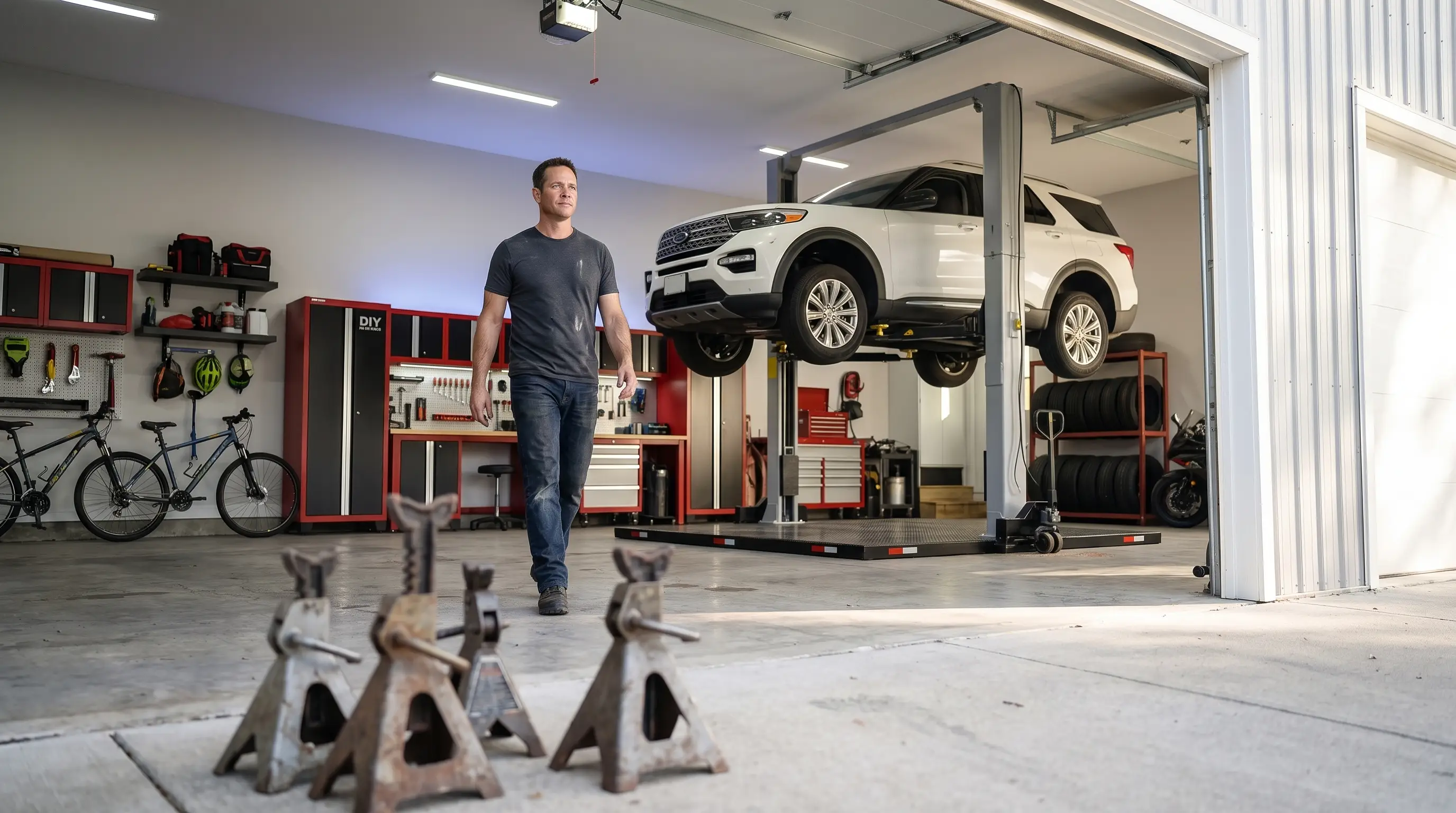
A garage lift raises the vehicle to a height where you can stand upright, work at eye level, and actually see what you're doing. That's not a luxury. For anyone who plans to keep turning wrenches for the next 10–20 years, it's a necessity.
This applies especially if you're a mobile mechanic or someone who does work for friends and family. If you've ever said, "I can't do that job at my place," your equipment is limiting your opportunities.
Mobile mechanics in particular lose income when they can't take on certain undercarriage jobs without access to a lift. A portable option that travels with you changes that equation completely.
The same logic applies to car collectors. If you're buying project vehicles but can't do the restoration work yourself because your setup doesn't support it, you're either paying someone else or the project sits. Neither is great.
Bad visibility leads to bad work. It's that simple.
When you're lying on a creeper, holding a flashlight in your teeth, trying to get a socket on a bolt you can barely see, mistakes happen. Incorrect torque specifications, overlooked connections, and incorrectly reinstalled parts are all common mistakes.
A lift raises the vehicle so you can actually walk under it, set up proper lighting, and see what you're doing with both hands free. That's a completely different working environment, and the quality of your work reflects it.
Research from OSHA (Occupational Safety and Health Administration) on ergonomics in skilled trades shows that better visibility and positioning directly reduce error rates. This isn't just about comfort. It affects the quality of your repairs and, ultimately, the safety of the vehicles you work on.
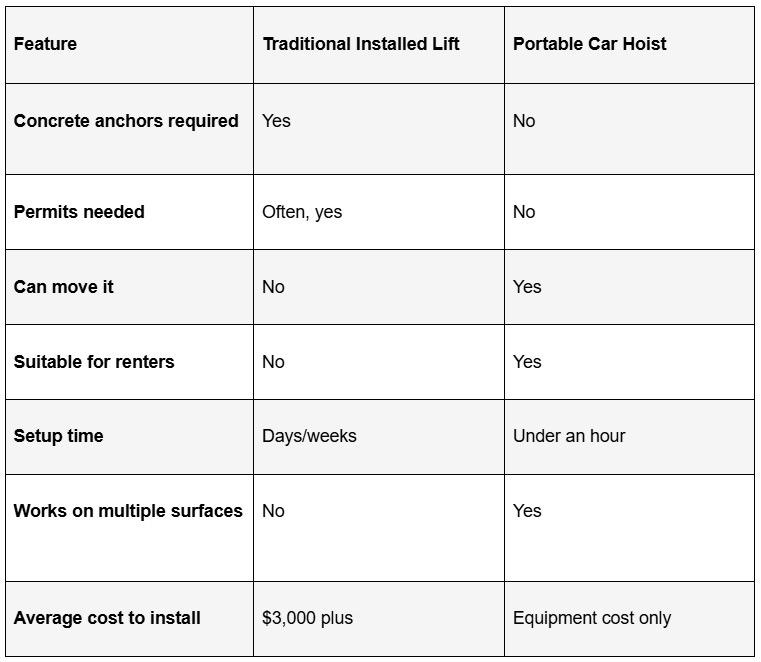
This is where a lot of serious mobile mechanics get stuck. They know they need a real lift. But a traditional two-post or four-post lift requires concrete anchoring, permits in most municipalities, a high ceiling, and a significant permanent installation.
For a lease, that's a non-starter. For mobile mechanics who are uncertain about their plans, it presents a significant challenge. For anyone working in a shared space or on a property with restrictions, it may be prohibited.
The good news is that a portable garage car lift doesn't have to be permanent to be professional-grade.
This is where portable lifts have revolutionized the landscape for mobile mechanics, collectors, and local mechanic shops.
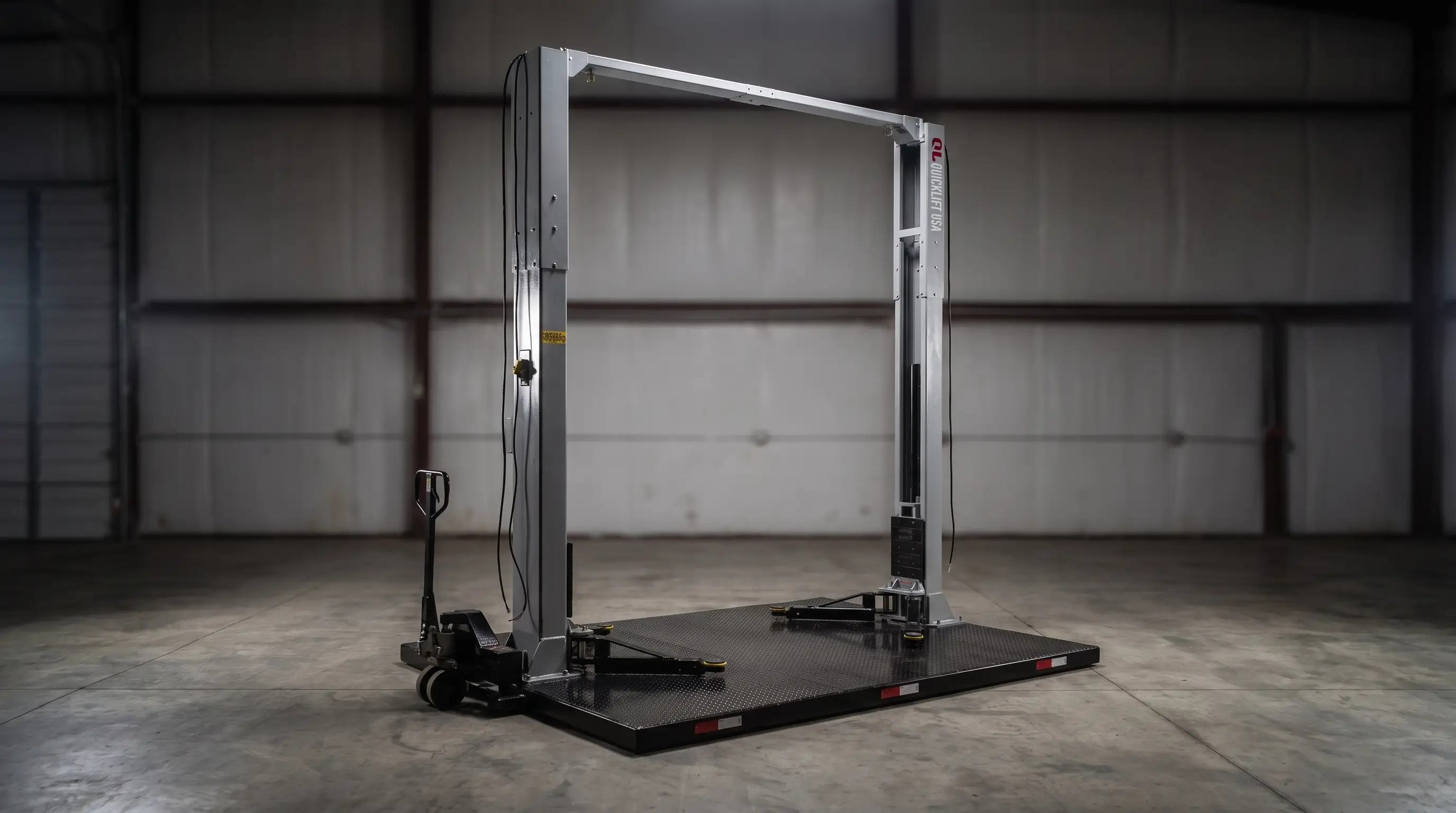
A quality portable car lift gives you professional lifting capacity, no concrete anchors, no permits, no permanent installation, and the ability to move it when you need to. You get all the benefits of a high-quality car lift for your garage shop without the commitment of a built-in system.
Here is a quick comparison to illustrate the difference:
To be honest, not everyone needs a lift. If you change your oil twice a year and that's it, quality floor jacks and stands will probably serve you fine.
But if you fall into any of these categories, a proper lift is worth taking seriously:
Not all lifts are built the same. If you're researching your options, here are the things that actually matter:
Know what you're lifting. A compact car and a full-size truck have very different requirements. Make sure the lift's rated capacity matches your heaviest vehicle with a comfortable margin.
A portable lift should work on concrete beyond perfect. If you need to use it on a track, asphalt, or a leveled outdoor surface, confirm the specifications before you buy.
The whole point of a portable lift is that you can move it. Check how long setup actually takes and whether one person can do it, or if you need extra hands.
Look for lifts certified or tested to ANSI/ALI standards. This is non-negotiable. The Automotive Lift Institute certifies lifts that meet specific load and safety requirements. If you're putting your body under a vehicle, the equipment needs to meet a real standard, not just a marketing claim.
Consider a mobile mechanic working out of a pickup truck. They're capable of handling most jobs, but anything requiring lift access meant turning away work or driving to a shop to borrow time on their bay.
After switching to a portable lift they could take to the customer's location, their revenue per week went up because they stopped saying no to jobs that required undercarriage access. The setup paid for itself within a couple of months.
That's not a hypothetical. It's the kind of story that shows up consistently when mechanics make the switch from improvised ground-level setups to a proper lift.
If you saw yourself in more than two or three of those seven signs, your current setup is costing you. It's costing you time, physical wear, job opportunities, and, in some cases, real safety risks.
Getting a proper car lift for your garage doesn't mean drilling into your floor, pulling permits, or spending $10,000. Portable options built to professional standards exist, and they've gotten genuinely good.
The question isn't whether you need a lift. It's how much longer you're going to work without one.
Portable Car Hoist builds American-made portable lifts designed for mechanics, collectors, and mobile shops that need professional performance without permanent installation. No concrete required.
Book a free 15-minute consultation, and we'll match you to the right model for your vehicles, your space, and your budget. Start your journey by visiting portablecarhoist.com.